NPOV is a narrative intelligence platform that makes manipulation visible. We investigate coordinated campaigns shaping information at the infrastructure layer- tracking threat actors, mapping networks, and connecting narratives as they travel through Wikipedia, Reddit, AI systems, and the wider information environment.
Impact Assessment
J.K. Rowling’s Wikipedia presence has been systematically reframed through sustained editorial intervention, transforming a biographical record into a controversy-dominated narrative.
This shift is not the product of normal editorial drift. It reflects a structured pattern of influence involving concentrated authorship, activist-aligned sourcing, hostile section weighting, and the repeated use of Wikipedia’s internal procedures to legitimize one-sided framing.
The result is a durable reputational distortion embedded in a high-authority knowledge system. Because Wikipedia serves as a primary upstream source for search engines, AI tools, and public reference systems, that distortion does not remain contained on the platform. It propagates outward, shaping how Rowling is described, evaluated, and morally framed across the wider internet.
Operational Snapshot
Page Authority & Reach
- Top 0.03% of all Wikipedia pages by traffic
- 210,495 pageviews in the last 30 days
- 12,352 total edits
- 3,808 total editors
- 1,772 page watchers
- Featured Article status, despite current neutrality concerns
Editorial Concentration
- Top 10 editors account for 3,835 edits, or 31% of all edits
- Top 3 editors control more than 50% of authored content
- SandyGeorgia: ~25%
- AleatoryPonderings: 13.9%
- Olivaw-Daneel: 11.9%
Campaign Signals
- Over 2,000 edits in 2022 alone, the largest annual burst since 2007
- Elevated editing has persisted since 2022
- Controversy-related sections show especially dense revision activity
Assessment Snapshot
AES-5: 4 (Highly adversarial, dominant editorial behavior)
NIS-5: 3 (Entrenched narrative influence on a high-impact page)
Why Wikipedia Is the Primary Battleground
Wikipedia is not merely a website where arguments happen. It is one of the central upstream nodes of the modern information system. For a figure like J.K. Rowling, whose page sits among the most-read author profiles online, Wikipedia functions as a narrative gateway: the place where millions of users, journalists, casual readers, and increasingly AI systems encounter a compressed account of who she is and what she represents.
That role is amplified by platform architecture. Wikipedia entries are pinned near the top of search results, scraped into Google’s knowledge environment, and used as training or retrieval substrate by major AI systems including ChatGPT, Gemini, Claude, and Perplexity. This means the practical significance of a hostile edit is not limited to a single paragraph on a single page. Once a framing becomes stable on Wikipedia, it can cascade outward into other systems that reproduce it as neutral knowledge.
In the Rowling case, this is precisely what makes the campaign so consequential. The target is not simply her Wikipedia biography. The target is the interpretive layer through which the wider internet now understands Rowling: not first as an author, philanthropist, or creator of one of the most successful literary franchises in history, but as a moral and political object organized around activist controversy.
Operational Analysis
Narrative Reframing at the Structural Level
The most consequential changes to Rowling’s Wikipedia presence are structural, not merely verbal. The page has been reweighted so that controversy occupies a central explanatory role in her biography. Achievements remain present, but they increasingly function as background to a more dominant narrative in which Rowling is defined by dispute, condemnation, and ideological conflict.
This structural change is most visible in the lead, the most consequential part of the article because it is the section most often read, quoted, scraped, and reused. The lead concludes with language stating that Rowling began making remarks opposing the idea that gender identity differs from birth sex and that she has been condemned as transphobic by LGBT rights groups, some fans, and various critics. As the report notes, this framing presents condemnation as the central fact of her recent public identity while omitting the existence of substantial support, serious legal and political debate, or the fact that her position is contested rather than universally discredited.
The effect is not outright falsification. It is something subtler and more durable: a narrative hierarchy in which criticism is foregrounded, support is backgrounded, and ambiguity is resolved in one ideological direction.
The “Transgender people” Section as Narrative Engine
The report makes clear that the “Transgender people” section is one of the most heavily edited and narratively loaded portions of the page. Its role is not incidental. It functions as the article’s main engine of reputational recoding.
The section is structured to privilege criticism, negative interpretation, and moral judgment. The report notes that it opens by asserting that Rowling is opposed to certain legislation and quickly moves into activist descriptors presented with insufficient distance from the article’s own voice. Terms such as “trans-exclusionary” appear without adequate clarification that they are contested political labels rather than neutral descriptors. Wording choices such as “mocked” and “fanned the flames” tilt interpretation against Rowling before the reader has encountered the fuller policy or legal context of the disputes being discussed.
The same pattern appears in how events are arranged. Rowling’s defense of Maya Forstater is described in a way that stresses escalation and backlash, while the later tribunal outcome in Forstater’s favor is downplayed. Her comments around Scotland’s hate crime legislation are framed as provocation, while the broader speech and legal context is minimized. Her own statements affirming that transgender people deserve to live in peace and security are included, but buried between accusations, functioning less as substantive position than as token disclaimer.
Even Rowling’s philanthropic work is folded back into the hostile frame. The report notes that initiatives such as Beira’s Place and the J.K. Rowling Women’s Fund are described through the lens of exclusion or controversy rather than mission. In effect, positive actions are not omitted; they are narratively repurposed.
June 2025 Neutrality Banner Operation
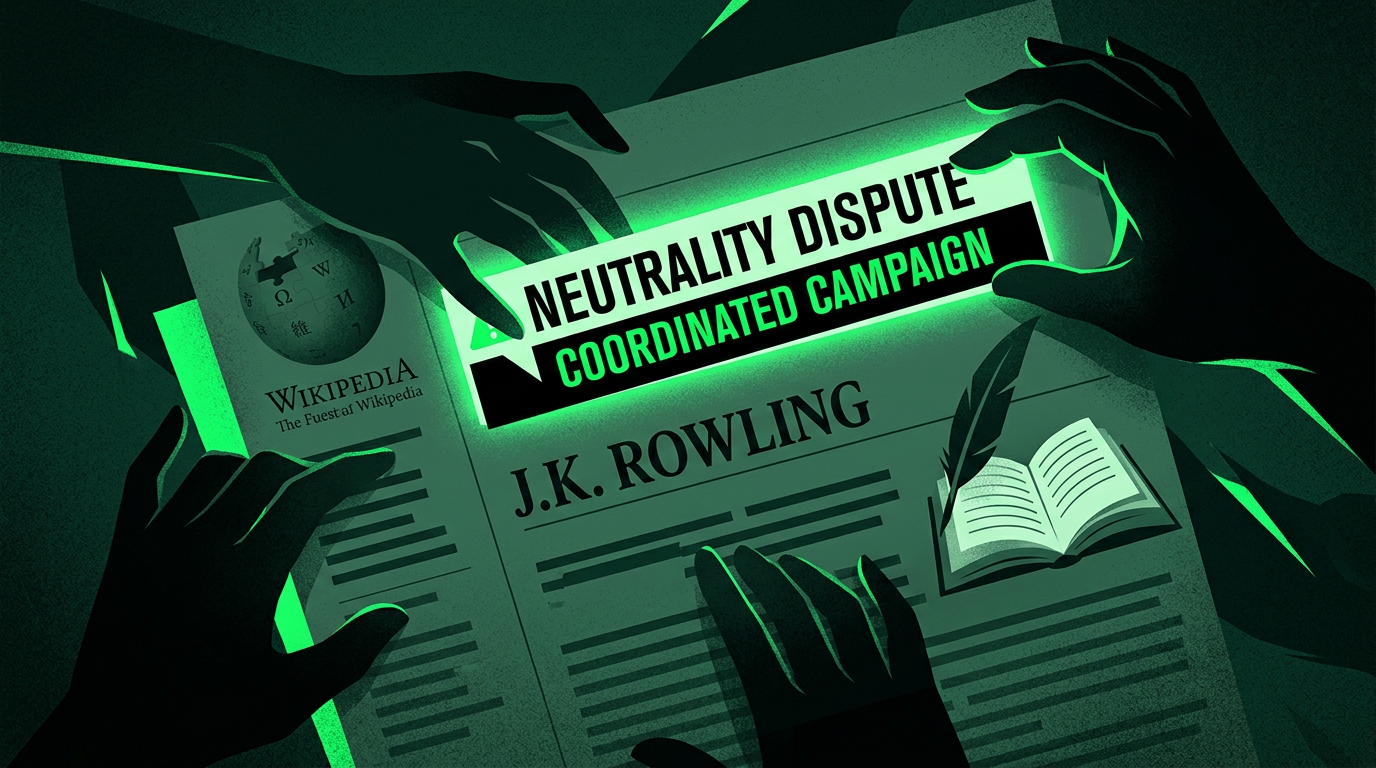
One of the clearest episodes in the campaign came in June 2025, when editor TarnishedPath inserted a neutrality warning banner at the top of Rowling’s biography. The issue was not factual inaccuracy in the ordinary sense. The dispute centered on whether the article should adopt activist-preferred labels such as “anti-trans” or “TERF” rather than terms like “gender-critical,” which Rowling herself and others use.
This episode matters because it reveals how procedural devices on Wikipedia can be weaponized. A neutrality tag is ostensibly an invitation to collaborative improvement. In practice, on a page of this prominence, it acts as a reputational signal. It tells millions of readers that the article is flawed in a way favorable to the subject and therefore that the subject herself is being insufficiently scrutinized. For nearly two months, this warning sat atop one of the most visible author biographies on the internet.
The talk-page dispute around the banner shows coordinated pressure. TarnishedPath pushed aggressively for activist terminology, citing search counts and noticeboard procedures to legitimize the effort. Editors such as LokiTheLiar and Simonm223 reinforced the push. Countervailing editors such as SandyGeorgia and Sirfurboy argued that terms like “TERF” are derogatory and inappropriate for neutral biography writing. Eventually an RFC ended with no consensus for imposing activist labels, and the banner was removed. But the report is right to note that the damage had already been done: the page had been publicly marked as suspect, and the dispute itself functioned as a mechanism for normalizing hostile terminology.
This is one of the clearest examples in the report of narrative warfare by procedure. The actors were not simply editing text; they were trying to redefine neutrality itself.
Editorial Network and Actor Structure
The campaign is driven not by a crowd of random contributors but by a recurring cluster of editors with overlapping histories on other contentious subjects. The report identifies several of these by name and role.
TarnishedPath emerges as the central procedural strategist in the June 2025 attack, leading the neutrality-banner push and linked to the previously exposed “Gang of 40” network. LokiTheLiar appears as a vocal advocate for activist-preferred terminology on gender-related pages. Simonm223 backed the banner and pushed similar framing. Starship.paint appears as an activist-aligned editor with cross-topic involvement, including in Israel–Palestine editing campaigns. Vanamonde93, a senior administrator, played a particularly important role because of his authority and because he authored portions of the article’s lead framing, including wording around Rowling being “widely” described as transphobic. MroWikipedian, though no longer central, left legacy contributions embedded in the article’s structure.
The report also places these figures in a wider network context. Five members of the previously identified “Gang of 40” edited the main J.K. Rowling article: Dimadick, Pincrete, Starship.paint, Surtsicna, and TarnishedPath. Additional editors including Aquillion, Buidhe, and Pincrete were involved in manipulative talk-page activity around the Rowling entry. On the “Political views of J.K. Rowling” page, editors such as Starship.paint, Vice regent, and XTheBedrockX appear.
That matters because the campaign is not best understood as one editor with one bias. It is a clustered environment in which a handful of actors, often working in small cells, reinforce one another across pages, procedures, and discussions. That model makes coordination harder to prove in a narrow sense, but easier to achieve in practice.
Expansion Through Parallel Articles
The parallel-article strategy is one of the most important mechanisms in the Rowling case, and it deserves to be understood not as a side issue but as a major component of the campaign.
The report describes “Political views of J.K. Rowling” as effectively a hostile dossier rather than a neutral companion page. That description is not rhetorical excess. The page serves a precise operational purpose: it lifts controversy out of the main biography, gives it its own expanded narrative territory, and then feeds that narrative back into the core Rowling page and the broader information ecosystem.
This has several important effects.
First, it multiplies narrative surface area. A reader or system querying Rowling does not encounter one contested page but a network of mutually reinforcing pages. The existence of a stand-alone “Political views” article implies that her political and ideological controversy is not peripheral but central enough to justify an entire companion dossier. That alone changes interpretive weight.
Second, it enables narrative density. Material that might appear excessive or unbalanced if concentrated in the main biography can be expanded at length in the parallel article. The report notes that nearly half of the “Political views” article is devoted to transgender issues. That is a remarkable concentration given the breadth of Rowling’s public life and political positions. The page’s lead reportedly declares her positions “transphobic” and links her directly to the derogatory label “TERF,” while her own explanatory essay is included mainly as a staging ground for criticism from Stonewall, Mermaids, and celebrity detractors.
Third, it creates recursive sourcing and framing loops. Once a stand-alone article exists, AI systems, search tools, and even Wikipedia editors themselves can treat it as an independent, article-level authority. It becomes available for citation, paraphrase, and cross-linking. The result is not just one hostile summary but an internally reinforced article ecology in which criticism is stabilized across multiple nodes.
Fourth, it changes search behavior and user pathways. A user searching whether Rowling is anti-trans, whether her books raise ethical issues, or what her views are on gender can be funneled not only to the main biography but to a dedicated controversy page whose very existence signals that this is the central lens through which she should be understood. The report’s downstream-effects material strongly suggests that this page plays exactly that role in AI and search outputs.
Fifth, it converts activist framing into archival structure. A transient campaign slogan or political accusation becomes encoded as article architecture. That is one of the most powerful forms of reputational capture available on Wikipedia, because structure outlasts individual edits.
The report is also right to connect this tactic to the broader methods of the “Gang of 40.” Creating splinter articles, repeating preferred framing across multiple entries, and interlinking them to create the appearance of consensus is not incidental. It is a tested playbook. In the Rowling case, the “Political views” page appears to function exactly this way: as an expansion chamber for controversy and a mechanism for fixing that controversy as the organizing truth of the subject.
Downstream Effects: Search, AI, and Narrative Replication
This is one of the most important sections of the report, because it shows that the campaign’s significance lies not only in what appears on Wikipedia, but in where that framing travels afterward.
The report states explicitly that Wikipedia has been chosen as the attack vector because it serves as the backbone of the internet’s knowledge infrastructure. In Rowling’s case, that means hostile framing on Wikipedia does not stay on Wikipedia. It appears in search, in AI outputs, and in recommendation contexts that affect consumer behavior and moral judgment.
ChatGPT
The report states that when users ask ChatGPT questions about Rowling’s views or whether they should read her books, the system reproduces the hostile framing from Wikipedia. It describes responses in which ChatGPT tells users not to read the Harry Potter series if they care about trans rights, characterizes Rowling as having participated in “anti-trans activism,” and gives only fleeting, subordinate acknowledgment of Rowling’s own stated empathy toward transgender people before returning to critics’ framing.
The report also notes that ChatGPT, when asked how Wikipedia influences its responses about Rowling, stated that its default framing is strongly consistent with how Wikipedia has structured and labeled the topic, and that Rowling is encoded primarily as a gender-critical or trans-exclusionary campaigner who also wrote Harry Potter, rather than as a literary figure with controversial views on gender. That is a highly significant finding because it points to an inversion of identity hierarchy: the literary achievement becomes secondary; the activist framing becomes primary.
Perplexity
The report states that Perplexity, when asked what it thinks of Rowling, devotes the longest paragraph in its response to criticism of her views on transgender issues and explicitly says that her public profile has become increasingly controversial. On the question of whether users should buy Rowling’s books, the report says Perplexity highlights ethical considerations, references boycotts, and recommends considering ways to avoid direct monetary support. It specifically identifies the “Political views of J.K. Rowling” page as a prominent source for these claims.
That matters because it shows a progression from biography to behavioral recommendation. The downstream system is not merely summarizing controversy. It is guiding the user toward a moralized consumer decision.
The report further states that Google search results concerning Rowling and even Harry Potter on trans issues are shaped by the “Political views of J.K. Rowling” article. This is important because Google occupies the first layer of public discovery for most users. Once a Wikipedia-derived controversy frame becomes dominant there, it affects not just direct readers of Wikipedia but anyone conducting adjacent searches.
The broader implication is that Wikipedia’s article architecture has succeeded in becoming search architecture.
The Mechanism
What ties these platforms together is not exact wording but the same directional effect. Across systems, Rowling is framed less as a major author with contested political views than as a cultural and moral problem whose work is entangled with ethical danger. That is the downstream signature of a successful narrative-targeting campaign.
The report is especially strong when it describes this as a form of data poisoning. The attack is hidden at the editorial layer, the actors are often anonymous, and the immediate edits may appear minor or procedural. But once those edits are absorbed by search and AI systems, they acquire extraordinary scale at very low cost to the actors who made them.
This is what makes the Rowling case so consequential. The campaign is not merely hostile. It is upstream.
Threat Assessment
The Rowling case is not best understood as an ordinary dispute over biography wording. It is a sustained attempt to alter the public meaning of a globally recognized figure by capturing and reorganizing the reference layer through which that figure is understood.
Three features make the threat especially serious.
First, the campaign operates through high-legitimacy infrastructure. The edits do not circulate primarily as obvious polemic or social-media outrage. They are embedded in Wikipedia, which carries the authority of neutrality, consensus, and referenceworthiness. That gives hostile framing unusual staying power.
Second, the campaign is structural rather than episodic. It does not depend on one defamatory sentence or one false allegation. It depends on article architecture: the lead, the weighting of sections, the creation of companion pages, the distribution of citations, the policing of labels, the use of procedural devices, and the persistence of a relatively small network of editors over time. Structural attacks are harder to reverse because they can survive changes in individual wording.
Third, the campaign has downstream replication power. Because major AI and search systems lean on Wikipedia so heavily, hostile framing on the source page becomes visible far beyond the platform. That changes the threat model. The issue is no longer simply that Wikipedia is unfair. It is that Wikipedia becomes the upstream mechanism through which unfairness is distributed as machine-readable fact.
In practical terms, the campaign appears to have achieved a significant degree of success. Rowling’s identity is repeatedly routed through a controversy frame; the “Political views” page acts as an expansion chamber for that frame; activist-preferred terminology is normalized through procedure and repetition; and downstream systems reproduce these patterns in ways that can affect public perception, media treatment, and consumer behavior.
This is not a state influence operation of the kind seen in the Iran report. But within the domain of reputational narrative warfare, it is a highly developed example of how a small cluster of editors can transform Wikipedia from a reference source into a durable instrument of ideological targeting.
Conclusion
The case of J.K. Rowling shows how a reputational campaign can be embedded in the architecture of Wikipedia and then scaled outward through search and AI systems.
What makes the attack effective is not simple hostility. It is the combination of concentrated editor control, hostile section weighting, procedural warfare, parallel-article expansion, and downstream machine replication.
Once that system is in place, a new narrative baseline emerges. Rowling is no longer encountered first as a literary figure who became politically controversial. She is encountered as a controversy that happens to have written books.
That is the real significance of the campaign. It does not merely criticize Rowling. It reorganizes how one of the internet’s core knowledge systems defines her.
Appendix — NPOV Scoring Framework
Adversarial Editor Score (AES-5)
- 0 — Neutral editing
- 1 — Mild bias
- 2 — Patterned bias
- 3 — Persistent adversarial behavior
- 4 — Highly adversarial, dominant editor
- 5 — Operational actor shaping narratives at scale
Narrative Impact Score (NIS-5)
- 0 — No impact
- 1 — Minimal impact
- 2 — Fragmented influence
- 3 — Entrenched narrative influence
- 4 — Systemic impact across layers
- 5 — Dominant narrative control
Interpretation
- AES-5 evaluates actor behavior
- NIS-5 evaluates system-level impact
Together, they provide a structured assessment of who is acting and what effect they are having.