NPOV / INVESTIGATION / TESLA TAKEDOWN
Inside Tesla Takedown
A public call became a distributed protest campaign aimed at Tesla’s sales and share price. We traced the actors, the tactics and the market line—and separated the campaign’s ambitions from what the evidence can prove.
On 8 February 2025, Initiator 01 posted a call to gather outside Tesla showrooms. The post pointed readers to store locations and used #TeslaTakeover. Two days later, Initiator 02 urged people to sell their Tesla vehicles and shares and join picket lines. The language made financial pressure part of the campaign from its opening week.
The next step was practical. Initiator 02 helped build a site where local actions could be listed under a common name. A domain record for teslatakedown.com gives 12 February as its registration date; the record does not identify who registered it. WIRED’s reporting describes that handoff; TechCrunch counted 42 US events listed by 14 February. By 25 February, The Verge counted 65 events on the campaign site. Those are snapshots of plans, not a count of people on the street.
THE PUBLIC RECORD / CAMPAIGN ACTIVITY
The campaign had a site, a channel, local organizers and volunteer tools.
The files show what selected actors did. They do not establish who directed whom.
08 FEB / FIRST CALL
Initiator 01
Called for showroom demonstrations, later shared campaign coverage and reported on a Boston protest.
10 FEB / AMPLIFICATION
Initiator 02
Added the appeal to sell vehicles and shares, join pickets and give local actions a common website.
12 FEB / PRESS BRIDGE
Organizer 01
Asked for protest locations to connect journalists with demonstrators; later promoted a Portland action.
22 FEB / LOCAL ACTION
Field participant 01
Reported a two-person London protest and later shared video from another local action.
22 FEB–01 MAR / TOOLS
Support account 01
Publicly described a campaign web app in development and promoted a profile-banner tool.
MARCH / CAMPAIGN VOICE
Campaign channel 01
Promoted mass action, shared Tesla business coverage, called for peaceful protests and commented on stock volatility.
Local action, shared infrastructure
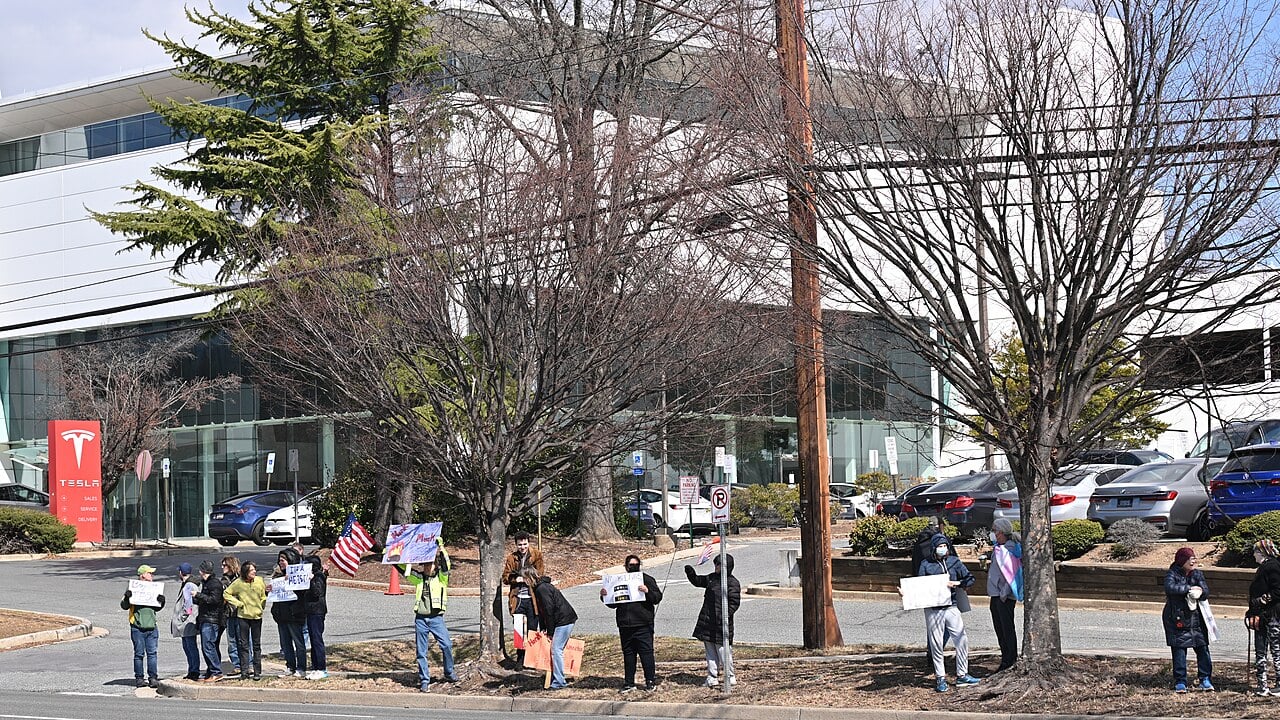
The site and its event pages made a simple idea repeatable: find a nearby showroom, post an event, turn up with signs, and give others a link to share. The protest itself remained local. A London participant’s February record described just two people at White City. In March, The Verge observed roughly 50 people at a different London showroom. Those accounts show local activity at two moments; they are not a measured attendance trend.
Press mattered too. On 12 February, Organizer 01 sought locations to connect journalists with demonstrators; that entry is reported without a recovered original permalink. FOX 13 Seattle identified Organizer 02 as helping with a 15 February protest. In an undated post preserved in a later screenshot, Organizer 02 said a Tesla-store protest drew three TV cameras and a local paper. That is a self-report, not a verified media count. Support account 01 later described a web app and a profile-banner tool. The files do not show how widely either tool was used.
The distinction matters. Our actor catalog includes local groups, support accounts, media channels and people who merely appeared alongside campaign activity. It is not a membership roll. Later field reporting described volunteers placing their own events on the site and local organizations joining actions. That is consistent with a distributed movement, but it does not turn every supporter into an organizer.
Financial pressure was a stated goal
Financial pressure appeared in the campaign’s first week, when Initiator 02 called for Tesla owners to sell cars and shares. In March, Campaign channel 01 linked coverage of a Cybertruck delivery hold, a customer boycott and insider stock sales while promoting protests. It also commented on TSLA volatility on 24 March. A separate screenshot saved that day shows Organizer 02 tagging Initiator 02 above a forecast of lower Tesla deliveries and asking how low the number could go. The number was vehicle deliveries, not TSLA’s share price. A public tag does not prove they planned together.
In a 21 March interview, Organizer 01 described financial pressure as a goal. The campaign’s public record supports that intent. It does not show how many shareholders sold because of a post, how many customers changed a purchase, or whether any particular trading day was moved by the protests.
One essay in our collected material proposed a separate social and media strategy aimed at Tesla’s stock. We classify its author as an adjacent commentator because the available record does not establish a formal campaign role. A campaign-branded account in the catalog also lacks proof of common control with the main channel. Neither is treated here as a direction from Campaign channel 01.
The March 29 push
On 19 March in US Eastern time, Campaign channel 01 called for a global day of action on 29 March. Its post sought more than 500 actions worldwide; reporting on the mobilization call described an ambition to reach every US showroom. The 500-plus figure was a target, not an achieved count. The channel followed with a call for peaceful protests and a link to the campaign site.
The weekend was visibly larger than the opening protests. AP reported demonstrations across the US and in parts of Europe; The Verge reported from ten anti-Tesla protests and also observed counterprotests. Organizers later told OPB that actions had occurred in at least 253 cities. We can report that claim; the supplied files do not independently verify a global city total.
Local numbers require the same care. Initiator 01 reported at least 500 people at a Boston protest on 22 March, an organizer estimate. A different local organizer self-reported more than 100 at a Burbank action on 20 April. Neither can be added to the city figure. The campaign publicly called for nonviolent protest. Our records do not link it to attacks on Tesla property, which WIRED reported separately.
THE MARKET RECORD / TSLA DAILY CLOSE
Tesla shares fell 38.6% by 10 March, then recovered unevenly.
Explore 62 daily closes from 31 January to 30 April 2025. Campaign dates provide context for the line.
SELECT A PRICE MILESTONE
$361.627 February 2025
Last trading close before the first public protest call.
Daily closing price in US dollars, 31 January–30 April 2025. Dotted markers locate the first call, the March global call, the March 29 action and Tesla’s April 2 delivery report; weekend events have no same-day close. The markers show timing, not effect.
Price source: Yahoo Finance historical data (NasdaqGS). Company context: Tesla Q1 2025 deliveries.
What the price drop meant to the campaign
Financial pressure was part of the campaign’s strategy from the opening week. Protesters urged owners to sell their cars and shares, while the campaign channel kept sharing stories about Tesla’s business. TSLA fell 38.6% between the last close before the first public call and 10 March. That gave the campaign a powerful story to tell, and the channel treated the slide as progress. On 19 March it posted, “It’s working! Keep it going!” while linking to a report about insider share sales.
The protests and boycott calls could have contributed to pressure on Tesla. But the chart cannot tell us how much. The same period brought weak sales reports, delivery concerns and a broader market selloff. On 10 March, AP reported that the Nasdaq lost 4% amid tariff concerns. Tesla shares also fell that day. On 2 April, Tesla reported first-quarter deliveries down about 13% from a year earlier.
The campaign won attention for its financial-pressure message and used the falling share price to sustain momentum. Its post shows what organizers believed they were accomplishing. The available records do not measure protest-driven sales or trading, so they cannot assign a share of the price fall to the campaign.
How we checked the record
NPOV reviewed 32 selected public post records from February to April 2025; two lack recoverable dates. The actor catalog contains 53 people, groups, channels and media entities, including supporters and entries with no recovered post. It is not a roster of campaign members. No historical engagement series is present, so we do not estimate reach or amplification from these files. Two supplied post screenshots were redacted and visually checked against the originals for text and dates; their displayed engagement totals were omitted because they were captured later. Two additional evidence cards are editorial typesetting: one summarizes a post reported by TechCrunch whose original was not recovered, and one excerpts a linked public campaign post. They are not screenshots. Two other supplied captures show a public tag about deliveries and a self-reported media turnout; neither shows the post’s absolute date.
The labels in this article are stable, role-based pseudonyms for actors with specific documented activity. We do not publish their source names or handles in this piece. A reported post without its original permalink is identified as such. Listed events, organizer attendance estimates, an organizer city claim and a campaign target are kept separate. The chart contains 62 daily market closes, not an analysis of causation.
Selected original source records can be checked against contemporary early reporting, the campaign’s March 29 call, and later field reporting.